








 Mythbusting ·
Do GLP-1s Cause Bone Loss?
·
Dr. Yoni Freedhoff ·


Longevity influencers can make it look like a long, healthy life comes in capsule form: a 20-pill morning routine, a multivitamin, an NAD+ booster and a scoop or two of something green. If you’re not doing any of that, it’s easy to wonder whether you’re missing something important.
You’re probably not.
Supplements can be useful, and some are essential in particular circumstances. But when it comes to living longer, no supplement has been shown to help healthy adults, and a lot of what’s sold as longevity-boosting support is expensive. The evidence is much less impressive than the marketing suggests.
In a pooled analysis of around 390,000 healthy adults followed for up to 27 years, taking a daily multivitamin was not associated with living longer (National Cancer Institute researchers, JAMA Network Open, 2024). While newer products such as NMN are attracting interest, we don’t have evidence that they extend our lifespan. So where is your time and money better spent? Let’s look at what the research actually tells us, when supplements are worth taking and what you can do to support your long-term health without the gimmicks.
For most healthy adults, there isn’t convincing evidence that they do. This is one of the most thoroughly studied questions in nutrition, and the answer has been consistent.
In a pooled analysis of randomized trials prepared for the US Preventive Services Task Force, multivitamins did not reduce deaths from any cause, from heart disease or from cancer (O’Connor et al., JAMA, 2022), and the Task Force concluded that the evidence is insufficient to recommend multivitamins for preventing heart disease or cancer. The large observational study I mentioned above points the same way: its authors concluded that taking a multivitamin to improve longevity is not supported.
There is a little more nuance here. The same evidence review found that multivitamins slightly lowered the chance of being diagnosed with cancer, though they didn’t reduce cancer deaths. This finding is worth knowing about, but it isn’t evidence that a multivitamin helps you live longer.
Nor does taking more mean you are getting more benefit. High doses of certain nutrients can cause harm, especially when there is no clinical reason to take them. For example, Health Canada cautions that high doses of vitamin E may increase the risk of heart disease and cancer in people who are at high risk for these diseases, and in trials, beta-carotene raised the risk of lung cancer in people at high risk, such as smokers.
There’s no convincing evidence yet that they help you live longer. This is where the difference between promising science and proven health benefits becomes particularly important.
NAD+ is a molecule involved in energy production and other essential cellular processes, and levels change with age, which has led researchers to investigate whether increasing NAD+ might help counter some aspects of ageing. NMN and NR supplements are sold as NAD+ boosters. NMN does raise NAD+ levels in the blood, but most clinical measures like blood sugar didn’t change, and a review of the trials found that NMN and NR did not improve muscle mass or physical function in older adults. The trials have been small and short, and there is no convincing evidence to date that these supplements will help you live longer, prevent age-related disease or maintain your independence for longer.
That doesn’t mean researchers should stop investigating them. It means we shouldn’t confuse an interesting research direction with a proven treatment.
When there’s a specific job to do. As of 2026, Health Canada’s advice is that when you eat a variety of nutritious foods, vitamin and mineral supplements are not generally required, with a few exceptions:
Everyday habits. A large study of US veterans looked at eight lifestyle behaviours, and each one was linked to lower mortality. Most of them will sound familiar:
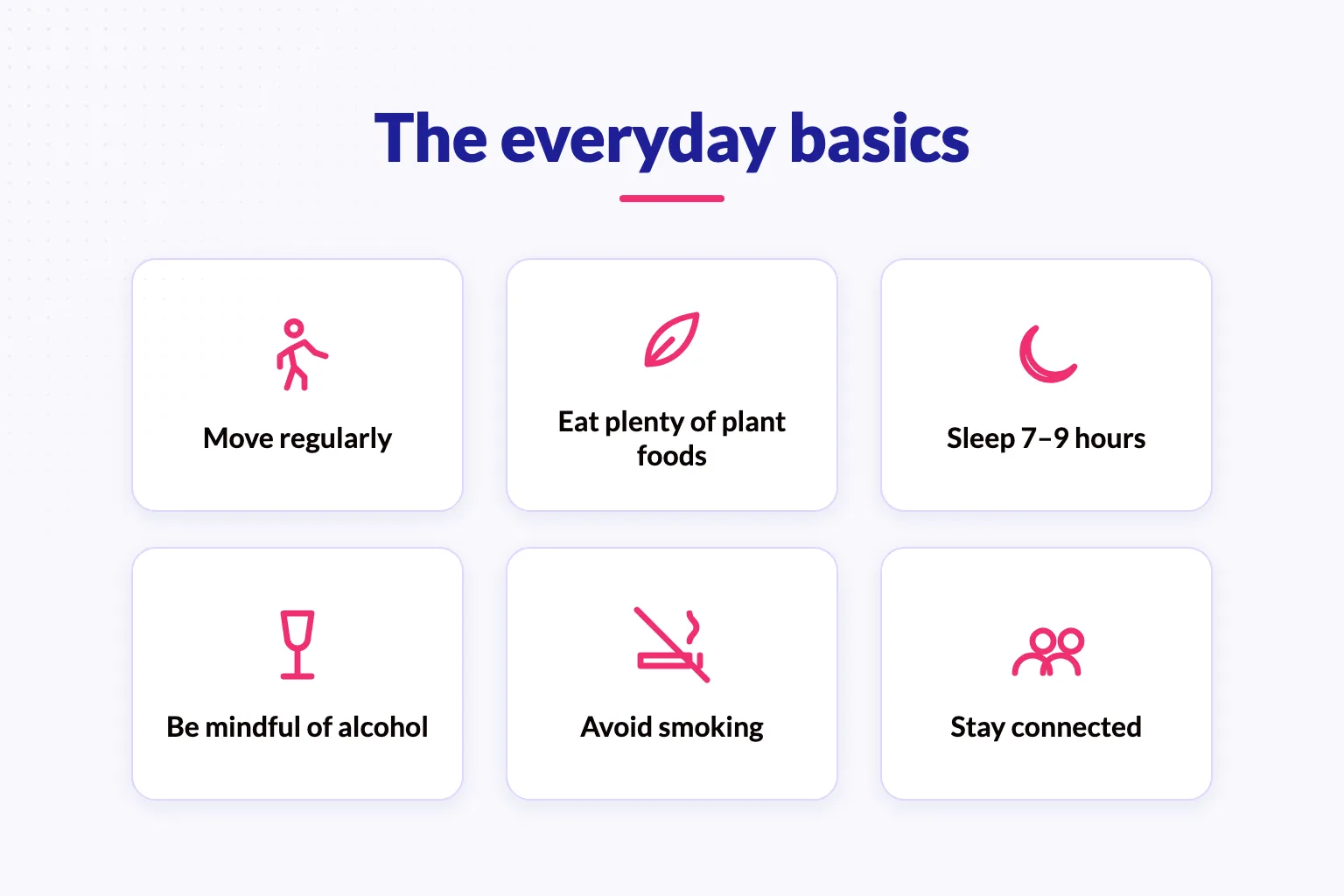
In two large cohorts of US health professionals, people with three healthy habits (never smoking, at least 30 minutes a day of moderate-to-vigorous activity and a high-quality diet) who also had a BMI between 18.5 and 24.9 had a projected life expectancy at 50 that was 11.4 years longer for women and 10.0 years longer for men than people with none of these. These are observational findings, so they don’t prove that these habits add a specific number of years to your life. But they do reinforce the point: when it comes to long-term health, the fundamentals matter considerably more than a cupboard full of supplements.
The researchers counted that BMI range as one of their low-risk factors, but weight isn’t a habit. Constant Health’s founding physician, obesity medicine specialist Dr. Yoni Freedhoff, has long encouraged people to aim instead for their best weight, which he describes as “whatever weight you reach living the healthiest life you honestly and actually enjoy.” The idea now appears in Canada’s adult obesity guidelines, which encourage clinicians across the country to consider using the concept of best weight. The habits are the part you can work on. Your weight is whatever comes along with them.
Absolutely not. In fact, trying to change everything at once can make it harder to maintain any of it!
In the veterans study, each additional healthy habit was associated with 19% lower mortality, so every one counts. And it’s not too late to start. People who were inactive for most of their adult lives but became active in their 40s to 60s had about the same lower mortality as people who had been active all along, and quitting smoking at 55 to 64 still gained about 4 years of life compared with continuing to smoke.
If you’re reading this and thinking you haven’t done much of any of it, that’s okay. Most people haven’t. Pick one thing that feels doable this week, like a walk after dinner, a can of beans in your soup or going to bed half an hour earlier, and see how it feels. If it sticks, add another. Small changes you keep are worth far more than a perfect plan you drop in a month. If you’d like more on building habits that last, our guide to habit-based nutrition coaching is a good next read.
Lifespan is how long you live. Healthspan is how many of those years you live in good health, and for most of us it’s the more useful thing to aim for. Most of us care less about the number on the cake and more about whether we’re still mobile, independent and able to enjoy life and the people around us. Everyday habits matter here too: in a study that followed more than 100,000 US adults from midlife, people whose diets scored highest on a healthy eating index had 86% higher odds of reaching age 70 free of major chronic disease, with their thinking, physical and mental health intact. Again, an association isn’t a guarantee. Genetics, environment, healthcare access and plenty of factors outside our control also influence how we age.
But we don’t need to control everything to do something useful. You don’t need to biohack your way to better health. Start with the things that have evidence behind them, choose changes that fit your life and leave room to enjoy it along the way.
Do multivitamins help you live longer?
No, not for most healthy adults. In a pooled analysis of about 390,000 healthy US adults followed for up to 27 years, people who took a multivitamin every day did not live longer than people who didn’t, and in randomized trials multivitamins did not reduce deaths from any cause, heart disease or cancer. A multivitamin with folic acid is still recommended for anyone who could become pregnant.
Are NAD+ supplements or other anti-ageing supplements worth it?
Not based on current evidence. NMN raises NAD+ levels in the blood, but trials have not shown that NMN improves most clinical measures, or that NMN or NR improves muscle or physical function, and no study has shown that they help people live longer.
Which supplements are actually worth taking?
The ones with a specific job. Health Canada recommends 400 IU of vitamin D a day for adults 51 and older, and a daily multivitamin with 0.4 mg of folic acid for anyone who could become pregnant. B12 may be needed by some older adults and people who follow a vegan diet, and anyone who is deficient, takes a medication that affects nutrient levels or has had bariatric surgery may need specific vitamins and minerals. Your doctor or dietitian can guide you to what supplements may be beneficial.
Is it too late to start healthy habits at 50 or 60?
No. People who became active in their 40s to 60s after being inactive had about the same lower mortality as people who had been active all their lives, and quitting smoking at 55 to 64 still gained about 4 years of life compared with continuing to smoke.
Fran Wild is the lead dietitian at Constant Health, specializing in diabetes and weight management since 2013. As a Certified Diabetes Educator with experience in working with individuals who have undergone bariatric surgery, Fran understands that everyone's nutritional needs and preferences are unique. She advocates for a sustainable approach to weight management and believes that lasting weight loss can be achieved without sacrificing the joy of eating!
Follow onContinue reading
Mythbusting ·  Mythbusting ·

 Mythbusting ·