










 Health ·
 Do GLP-1 Medications Cause Hair Loss? What the Evidence Shows — and What Helps
·
Fran Wild ·
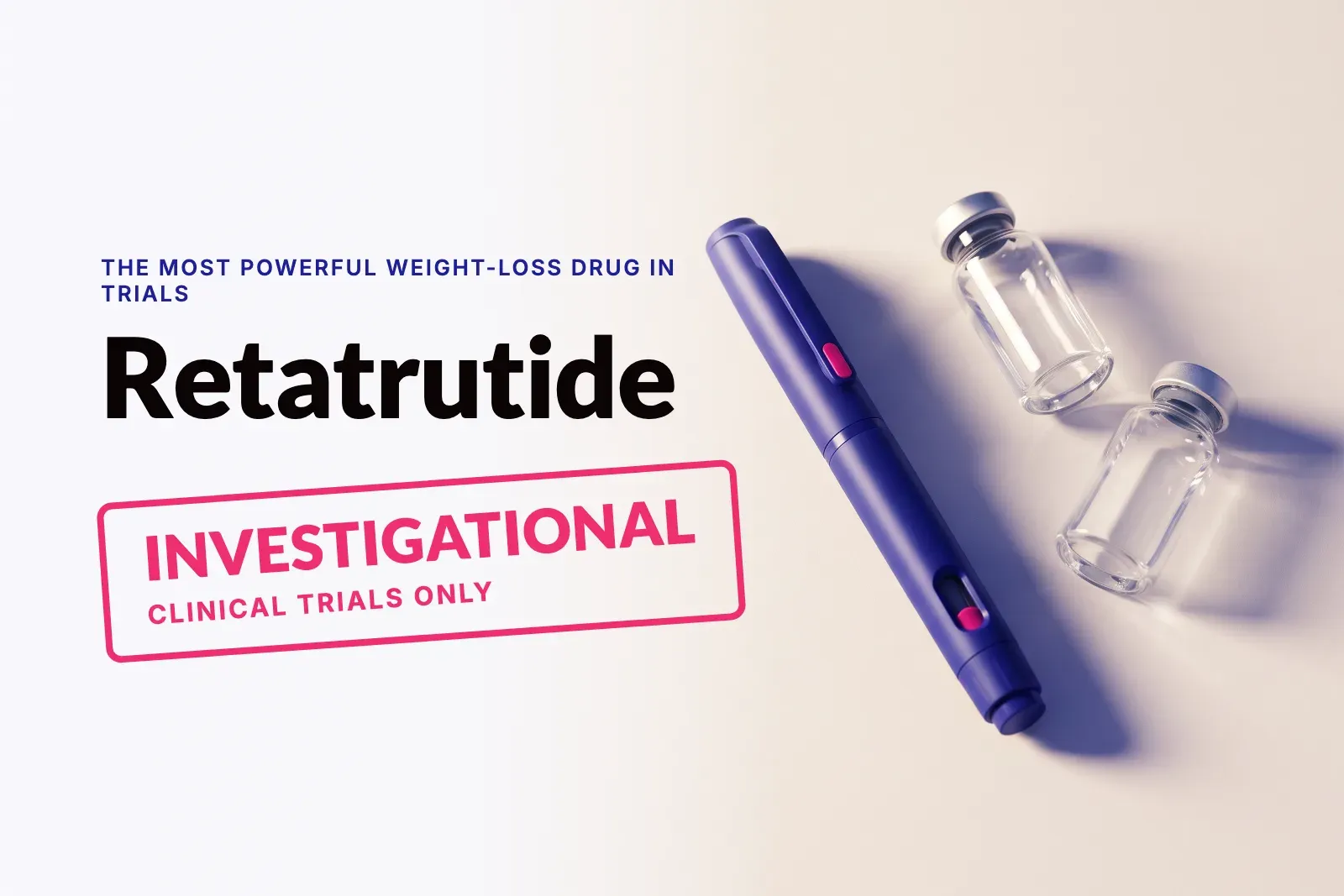
If you’ve landed here, you’ve probably seen the headlines calling retatrutide the most powerful weight-loss drug ever tested, and you want to know two things: is that real, and can you get it? The first answer is a qualified yes. The second is a flat no.
Retatrutide is an investigational once-weekly injection that, in trials, has produced the largest weight loss yet reported for an obesity drug: around 24% of body weight over 48 weeks in a peer-reviewed phase 2 study, and roughly 28 to 30% over 80 to 104 weeks in phase 3 data presented in 2026 (not yet peer-reviewed). It is not approved by the FDA, by Health Canada, or by any regulator anywhere, and it cannot be prescribed outside a clinical trial. Anything sold online as “retatrutide” today is an unregulated research chemical, not the trial drug. So the practical answer for right now is simple: understand it, be excited about it, and don’t buy it.
Retatrutide is a single once-weekly injectable peptide that switches on three receptors at once: glucagon-like peptide-1 (GLP-1), glucose-dependent insulinotropic polypeptide (GIP), and glucagon. Semaglutide (Ozempic, Wegovy) is a pure GLP-1 drug. Tirzepatide (Mounjaro, Zepbound) adds GIP. Retatrutide adds the third one, glucagon, and that’s the whole story of why it behaves differently.
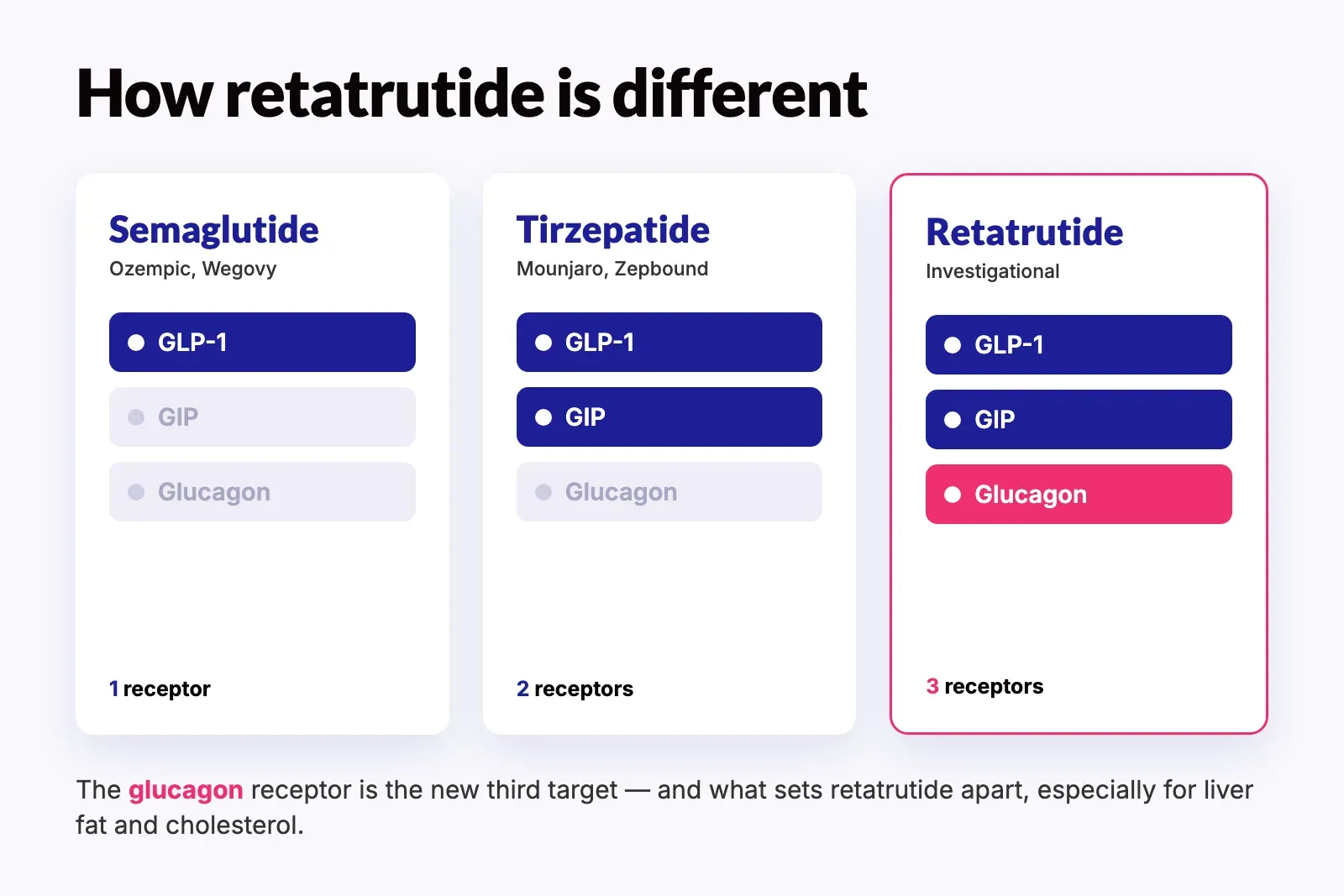
The molecule is deliberately lopsided. Compared with your own natural hormones, retatrutide is markedly more potent at the GIP receptor and less potent at the glucagon and GLP-1 receptors (phase 2 trial, NEJM 2023). The interesting part is the glucagon.
Most people know glucagon as the hormone that raises blood sugar, so adding it to a diabetes drug sounds backwards. But glucagon also drives the liver to burn fat, and that appears to lead to retatrutide effects its two-hormone cousins don’t reliably deliver: a direct hit to liver fat and to blood lipids. In a phase 2a trial in people with fatty liver disease, the top dose cut liver fat by around 82% relative to baseline over 24 weeks (Nature Medicine 2024). That’s a bigger liver-fat reduction than the approved incretin drugs have posted in their own trials: tirzepatide cut liver fat by roughly 57% at its top dose in a NASH study (NEJM 2024), and semaglutide roughly halved it (Aliment Pharmacol Ther 2021). As with the weight numbers, though, those are separate trials in different patients, not head-to-head. And in the obesity trial, LDL (“bad”) cholesterol fell about 20%, a drop the investigators attribute partly to a direct effect of glucagon on the liver’s cholesterol handling, not to weight loss alone (NEJM 2023). That liver-and-lipid mechanism is still being worked out, but it’s the genuinely novel piece.
A lot, more than any obesity drug tested before it. The largest trial to date, the phase 3 TRIUMPH-1 (~2,339 people), put average weight loss at the top dose at 28.3% over 80 weeks, climbing to 30.3% by two years in an extension group, with knee-arthritis pain and sleep-apnea events both dropping sharply. One caveat rides with those numbers, and it’s an important one: they were presented at the 2026 American Diabetes Association meeting and released as a company topline, and haven’t yet been through peer review (Lilly, May 2026). Presented data from a phase 3 trial is a strong signal, but it isn’t the same thing as a published paper, and you should file it that way until the manuscript lands.

The peer-reviewed anchor is the earlier phase 2 obesity trial: at the 12 mg dose, people lost an average of 24.2% of their body weight at 48 weeks, versus 2.1% on placebo (NEJM 2023). For someone starting at 250 pounds, that’s about 60 pounds gone in under a year.
And the categorical numbers are what make obesity doctors sit up. At that top dose, 83% of people lost at least 15% of their weight, nearly two-thirds lost 20% or more, and more than a quarter lost 30% or more. That last figure is the one that matters: 30% total weight loss is the range we associate with bariatric surgery, not with a drug. On top of that, the weight-loss curve had not plateaued when the trial ended. People were still losing.
So is retatrutide “the most powerful”? On the numbers, it out-loses every approved drug we can compare it to. But every one of those comparisons is cross-trial: different studies, different patients, different designs, and not one head-to-head trial against tirzepatide or semaglutide has reported yet. Those trials are running now. Until they read out, “the strongest results we’ve seen” is the honest claim; “proven better than Mounjaro” isn’t, at least not yet. My own read: if these trial results hold up in the real world, retatrutide turning out to be the most powerful of the group is the likeliest outcome. But likeliest isn’t proven, and the head-to-head trials are what will settle it.
Here the evidence is peer-reviewed and, frankly, striking. In TRANSCEND-T2D-1, a phase 3 trial published in The Lancet, retatrutide was given as the only diabetes medication to 537 adults with early type 2 diabetes who weren’t on anything else (Lancet 2026).
From a starting A1C of 7.9%, the drug lowered A1C by up to 1.94% at 40 weeks, versus 0.81% on placebo. In plain terms, average A1C at the top dose landed near 5.9%, a genuinely normal number, and between 35% and 40% of people on retatrutide reached an A1C below 5.7%, which is the non-diabetic range. All of that happened with no severe hypoglycemia reported in the entire study. People lost weight too: about 15.3% at the top dose, and again the curve hadn’t flattened.
Two things keep this honest. These were early patients with diabetes, with an average duration of two and a half years, and largely medication-naïve, so the results don’t automatically transfer to someone who’s had diabetes for fifteen years and is already on three drugs. And the trial ran for 40 weeks, which is short. But as a picture of what this drug can do to blood sugar early in the disease, it’s about as good as diabetes data gets.
The safety profile so far looks like the GLP-1 family you already know about, which is reassuring. The novelty is in the efficacy, not in some alarming new risk. The most common side effects across the trials were gastrointestinal (nausea, diarrhea, vomiting), mostly mild to moderate, and concentrated during the weeks when the dose was being stepped up (NEJM 2023; Lancet 2026). In the diabetes trial, discontinuations for side effects ran 2 to 5%.
A couple of specifics worth knowing. Retatrutide nudges heart rate up, the way GLP-1 drugs do; in the phase 2 obesity trial that rise peaked around 24 weeks and then came back down, and in the diabetes trial the average change was only about one to two beats per minute. It also lowers blood pressure and cholesterol, which is good, but means anyone on blood-pressure medication would need real monitoring rather than a set-it-and-forget-it prescription. None of this is a reason for alarm. All of it is a reason this belongs with a clinician, not in a bathroom cabinet. Which brings us to the part that actually matters right now.
No. Retatrutide is investigational. Its manufacturer states plainly that it “is not currently approved by the FDA and is considered an investigational medication,” and that it’s “legally available only through clinical trials” (Lilly). No New Drug Application has even been filed as of mid-2026, and Health Canada hasn’t authorized it either. A realistic approval timeline is 2027 at the earliest, more likely 2028.

Here’s where honesty about the supply matters, because a drug this hyped and this unavailable creates a vacuum, and something has rushed to fill it. There is a booming gray market selling “research peptide” retatrutide in vials online. Please don’t use it. And the reason isn’t red tape. It’s that you have no idea what’s in the bottle.
With approved drugs, at least there’s a regulated version to counterfeit against. Retatrutide doesn’t even have that. There is no legitimate compounded retatrutide anywhere, because there’s no approved product to compound from, so 100% of what’s being sold is unregulated by definition. The FDA has documented what this category does at its worst: unapproved and counterfeit GLP-1-type products that contain the wrong ingredient, too much drug, too little, or none at all, made without sterility oversight and sometimes shipped warm (FDA). Health Canada warns Canadians of the same thing: unauthorized GLP-1 products it has never assessed for safety, effectiveness, or quality, which can carry too much, too little, or none of the active ingredient, or contamination ranging from heavy metals to bacteria (Health Canada). Peptides are fragile molecules. A vial of mystery powder from an unregulated seller, self-dosed at home, isn’t “getting ahead of the approval.” It’s a different and worse risk than the drug the trials studied.
If you’re carrying significant weight or managing type 2 diabetes today, the useful move isn’t to chase retatrutide, it’s to use what’s proven and available. Semaglutide and tirzepatide are approved, studied for years, and work well for most people who take them. They are not consolation prizes.
Where retatrutide will fit once it’s approved is genuinely an open question, and one we don’t yet have the data to answer. Here’s my honest read: if its risks turn out comparable to the drugs we already have, and if access and coverage were equal, I’d generally reach for the most effective option, with some nuance about who needs what. Someone with a lighter starting weight might do just as well on a lower dose or a gentler drug, especially if that means fewer side effects. But that’s a judgment for real-world experience and more data to refine, not something today’s trials settle. If you’re on a GLP-1 now and it’s working, keep going and talk with your own clinician about whether anything should change. If you’ve plateaued or you’re weighing your options, that conversation, not an online vial, is where the next step lies.
Retatrutide is the most exciting medication in the obesity-drug pipeline, and the excitement is earned: the numbers are real, the mechanism is genuinely new, and for a lot of people it will eventually be a very big deal. It’s also two-plus years from a pharmacy shelf, and the version you can buy today isn’t it. Be excited. Be patient. But keep the mystery vials out of your fridge.
Is retatrutide FDA approved?
No. As of mid-2026 retatrutide is investigational and has not been approved by the FDA. Its manufacturer has not yet filed a New Drug Application, and it is available only through clinical trials.
Is retatrutide available in Canada?
No. Health Canada has not authorized retatrutide. It is not approved or available for prescription in Canada outside of a clinical trial.
When will retatrutide be approved?
There’s no confirmed date. With no application yet filed as of mid-2026 and standard review timelines, approval is unlikely before late 2027 and may land in 2028.
How much weight can you lose on retatrutide?
In a peer-reviewed phase 2 trial, people on the top dose lost an average of 24.2% of their body weight over 48 weeks. Phase 3 data presented in 2026 (not yet peer-reviewed) showed averages of roughly 28–30%.
Is retatrutide better than Ozempic or Mounjaro?
On the trial numbers so far it produces greater weight loss, but no completed, published trial has compared retatrutide directly against semaglutide or tirzepatide. Head-to-head trials are underway; until they report, any “better than” claim is a cross-trial impression, not proof, even if it looks like the most likely outcome.
Is it safe to buy retatrutide online?
No. There is no approved or legitimately compounded retatrutide, so anything sold online is an unregulated research chemical of unknown dose and purity. Regulators have documented wrong ingredients, incorrect dosing, and contamination in unapproved GLP-1-type products.
What is a triple agonist?
It’s a drug that activates three hormone receptors at once, in retatrutide’s case GLP-1, GIP, and glucagon. GLP-1 drugs hit one of these and tirzepatide hits two; the added glucagon activity is what sets retatrutide apart, particularly for liver fat and cholesterol.

Since 2004, Dr. Yoni Freedhoff, an Associate Professor of Family Medicine at the University of Ottawa, has dedicated his practice to obesity medicine. Canada's most outspoken obesity expert, Dr. Freedhoff is regularly sought out by the international media for commentary on nutrition and weight matters, and for his book, The Diet Fix: Why Diets Fail and How to Make Them Work. Dr. Freedhoff's diet agnostic philosophy and lessons learned from working with over 10,000 patients is the foundation of what Constant Health has been built upon.
Follow onContinue reading
Health ·  Health ·
 Health ·