










 Health ·
 What Is Retatrutide? The Evidence, the Hype, and the Gray-Market Risk
·
Dr. Yoni Freedhoff ·
If you’ve started a GLP-1 medication and you’re suddenly seeing more hair in the shower drain, you’re not imagining it, and you’re far from alone.
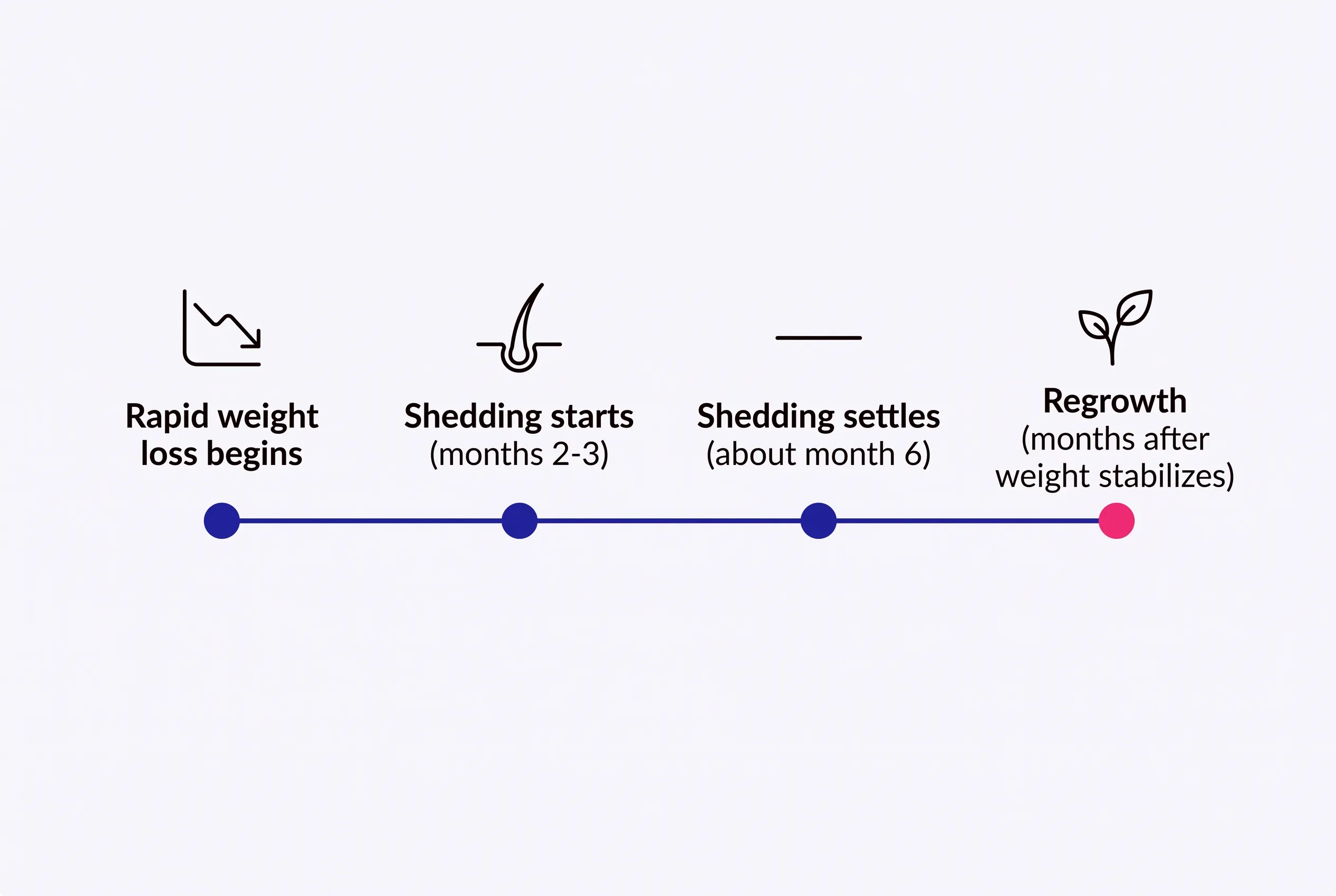
Yes, hair loss is listed as a possible side effect for these medications, however the evidence points to rapid weight loss itself as being the main cause, rather than the drugs directly damaging your hair. This type of hair shedding is called telogen effluvium and the good news is that it is usually temporary. Typically it starts two to three months into significant weight loss and the hair growth cycle returns to normal when your weight stabilizes. In trials, hair loss affected 3% of people on semaglutide (Wegovy) versus 1% on placebo, and 4–5% of people on tirzepatide (Zepbound) versus 1% on placebo. If you are concerned about hair loss during weight loss, the most useful things you can do are protect your protein and nutrient intake and give it time.
Yes: hair loss happens on GLP-1 medications more often than on placebo, but the evidence says the medication is mostly an indirect cause. In the trials behind Wegovy (semaglutide 2.4 mg), 3% of adults reported hair loss versus 1% on placebo. For Zepbound (tirzepatide), it was 4–5% across doses versus 1% on placebo. A 2026 systematic review in Science Progress that pooled the available studies put the overall rate at 6.0 per 1,000 patient-years on GLP-1 therapy versus 0.8 on placebo, which the review characterizes as roughly a three-fold increased risk. Either way, it’s uncommon in absolute terms.
Now the more useful question: is it the drug, or the weight loss? The Zepbound label states plainly that hair-loss reports in its trials “were associated with weight reduction.” The same systematic review found shedding tracked how much weight people lost (5.3% in those losing more than 20% of body weight versus 2.5% in those losing less), and that semaglutide doses below 2 mg weekly, the diabetes range, were rarely implicated.
There is one caveat: most of the shedding seen on GLP-1 medications tracks the speed and size of the weight loss itself, however, one large medical-records study (JAAD, 2026) also found higher rates of other hair-loss types, including androgenetic alopecia, that weight loss alone wouldn’t explain, so researchers are still investigating whether the drugs make a smaller direct contribution. That study relied on diagnosis codes rather than dermatologist assessments, and the medication group still lost more weight than the comparison group, which is why the weight-loss explanation remains the best-supported one.
Because your hair follicles respond to the stress of an energy shortfall by hitting pause, a pattern dermatologists call telogen effluvium. At any moment, most of your hairs are growing and a small share are resting. A significant physiological stress (rapid weight loss, surgery, illness, childbirth) shifts an unusually large share of follicles into the resting phase at once. Those hairs all release around 2–3 months later, which is why the shedding seems to come out of nowhere months after you started the medication.
We’ve seen this pattern for years in bariatric care, long before GLP-1 medications existed. A meta-analysis of 18 studies found hair loss affected 57% of people after bariatric surgery, with no drug involved at all. That number falls with time (58% within the first year, 35% after), which fits the temporary, self-resolving pattern. If anything, it’s a useful reframe: the shedding is a marker of how much your body is changing, not a sign something is wrong with your hair.
Women, people losing weight quickly, and people struggling to eat enough protein: those are the patterns in the data. In the pooled Zepbound trials, hair loss was reported by 7.1% of women versus 0.5% of men. The Science Progress review found the same female predominance across studies, along with the weight-loss gradient: the more you lose, and the faster, the more likely the shed. That gradient also explains the difference between drugs. In the first head-to-head obesity trial, tirzepatide produced larger weight loss than semaglutide (20.2% versus 13.7% of body weight over 72 weeks), which fits its slightly higher shedding rates.
Nutrition status matters too. In the bariatric meta-analysis, people with hair loss had lower zinc, ferritin (your body’s iron stores), and folate than those without, while serum iron and vitamin B12 showed no association. That’s worth knowing, because it points you at the right tests rather than a shelf of hair supplements.
And if you’re finding it hard to eat much while taking these medications you’re not alone. Appetite suppression is one of the ways they work. But when you are eating less it’s important that every bite counts, so try to make your smaller meals as nutritious as possible.
If even small meals and snacks are feeling challenging then speak to your prescriber. It can be helpful to feel satisfied with less, but feeling satisfied with almost nothing isn’t good for your health! Even with a smaller appetite your body needs enough nutrition to function well.
For typical post-weight-loss shedding, yes. Telogen effluvium is non-scarring: the follicles are resting, not gone. Shedding generally settles within about 6 months, regrowth follows over the 3–6 months after the trigger eases (for most people, once weight loss slows or stabilizes), and cosmetically full recovery can take 12–18 months. Patience is genuinely part of the treatment here, unsatisfying as that is to hear.
The 2026 review’s counselling guidance draws the line well: shedding that persists beyond 6–9 months, comes out in patches, or arrives with scalp symptoms like itching or scaling isn’t the typical pattern; that’s the point to see your doctor or a dermatologist, who can check for other causes such as thyroid issues, low iron stores, or androgenetic (pattern) hair loss.
When you are eating less, every bite matters. Here are some evidence based strategies that may be helpful to experiment with to help you meet your nutritional needs with a smaller appetite.
Unfortunately, there’s no guarantee that these strategies will prevent hair loss, but they can help reduce some of the nutritional factors that may contribute to increased shedding:

One thing I’d encourage you not to do: stop your medication in a panic over shedding. Whether a medication is right for you is a decision between you and your prescriber, but it’s worth walking into that conversation knowing the shedding is usually temporary and tied to the weight change itself. If you’re on a GLP-1 and wondering what else changes along the way, our piece on why people stop these medications covers the bigger picture, and rapid weight loss has a similar story with bone density (same mechanism, same nutrition-first response).
Hair shedding a few months into GLP-1 treatment is common, and while it can be understandably worrying, it usually isn’t a sign that something has gone wrong. In most cases, it’s your body responding to fairly rapid weight loss and the changes that come with it.
Focus on giving your body what it needs: enough protein, adequate overall nutrition, and time. Keep an eye on how things change over the next few months, and most likely your hair growth will return to normal.
Does hair grow back after Ozempic or Wegovy hair loss?
Yes, in the typical case. The shedding is usually telogen effluvium, a non-scarring hair loss in which follicles rest rather than die. Shedding settles within about 6 months, regrowth follows over 3–6 months once weight stabilizes, and full cosmetic recovery can take 12–18 months.
How long does GLP-1 hair loss last?
Shedding typically begins 2–3 months after rapid weight loss starts and lasts around 6 months before settling. If shedding continues beyond 6–9 months, is patchy, or comes with scalp symptoms, see your doctor or a dermatologist to check for other causes.
Does Mounjaro or Zepbound cause more hair loss than Ozempic or Wegovy?
Trial rates are somewhat higher for tirzepatide (Zepbound: 4–5% vs 1% placebo) than semaglutide (Wegovy: 3% vs 1% placebo). Tirzepatide also tends to produce larger weight loss, which fits the evidence that shedding tracks the amount of weight lost rather than the specific drug.
Do hair supplements help with GLP-1 hair loss?
The nutrients actually associated with post-weight-loss hair loss are zinc, ferritin (iron stores), and folate, not serum iron or B12. Rather than buying a supplement stack, ask your care team about testing those levels and supplementing only where a gap shows up, alongside adequate daily protein.
Should I stop my GLP-1 medication if my hair is shedding?
That decision belongs with you and your prescriber, but it helps to know the shedding is usually temporary, tied to the pace of weight loss rather than drug damage to follicles, and typically regrows as weight stabilizes, even though researchers are still studying whether the drugs make a smaller direct contribution.

Fran Wild is the lead dietitian at Constant Health, specializing in diabetes and weight management since 2013. As a Certified Diabetes Educator with experience in working with individuals who have undergone bariatric surgery, Fran understands that everyone's nutritional needs and preferences are unique. She advocates for a sustainable approach to weight management and believes that lasting weight loss can be achieved without sacrificing the joy of eating!
Follow onContinue reading
Health ·  Health ·
  Health ·